
Feed the world? It’s up to us peasants

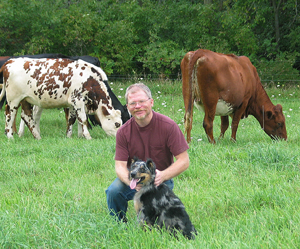
Farmer with dog and cows

By Joel McNair

I’ve a dairy grazing friend who has long thought of himself as being nothing more than a peasant. A rather interesting view, I’ve thought, given that this man has made a fair amount of money operating at a scales far beyond those of the traditional midwestern dairy farmer. His house is nicer than mine.

A peasant he probably is, though, if one considers the size and clout held by agriculture’s true power brokers. ConAgra, Cargill, Monsanto, Smithfield/Shuanghui — an individual farmer cannot stand up to the likes of these behemoths no matter how many acres he might till or cows he can milk. One need look only at the history of our agricultural policy: What was once concerned primarily with keeping individuals on the land has morphed into something that is almost entirely about keeping food flows and processing/marketing profits on the upswing. Continue reading “Feed the world? It’s up to us peasants”
A story about the real meaning of real food

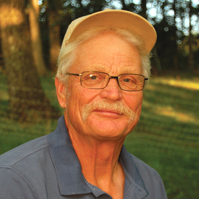
Jim VanDerPol

By Jim Van Der Pol

Kerkhoven, Minnesota — There is a trendy new “Foodie” culture, of which we are a part. We sell into it. We also never gave up cooking in our house. The Foodies often point out a generational difference in this way:

Your mother or grandmother, they say, might ask you after eating if you got enough, thus linking the provision of food with the concept of food as fuel. Your wife (husband?), lover, or live-in who cooks is more likely to ask if it was good, putting food and eating into the vicinity of sex, where the sensation is at least as important as the result. Foodie culture blames the first comment for all manner of modern ills, such as overeating and the consumption of bad food. And while it admires your grandmother for knowing the uses of a pot, it tut-tuts over her idea of a human as a hole to be filled. Continue reading “A story about the real meaning of real food”

The pattern of problems and solutions

Jim VanDerPol

By Jim Van Der Pol Kerkhoven, Minnesota — One pattern sometimes holds true in several different venues. That is true now of doctoring and farming, both of which are in a pretty advanced state of decay. Thoughtful people in both these areas are wondering how long the current practices and ideas can hold up.

Bruce Lipton, in his book The Biology of Belief, points out that it is conventionally accepted that 120,000 people die in the U.S. each year from adverse reactions to drugs. This would make prescription drugs the third leading cause of death. However, this count is obsolete, having been made in 2000. A 10-year survey of government statistics completed in 2003 shows that the real number may be closer to 300,000, making drugs the leading cause of death, according to Lipton. You will notice, of course, that this number never got talked about in our recent “health care debate.” But it presents the practitioners of conventional medicine with a picture of the dead end they are on, along with the knowledge that change is no longer just desirable, but absolutely necessary. Continue reading “The pattern of problems and solutions”

The problem with Roundup Ready food

Farmer with dog and cows

By Joel McNair, Belleville, Wisconsin —For a few years now — basically since his retirement from Purdue University — plant pathologist Don Huber has been telling people that there are serious problems with glyphosate (Roundup).

To date most of the discussion has taken place within the world of soybeans. Based on two decades of his own research along with the findings of other scientists, Huber is certain that glyphosate is reducing the ability of the soybean plant to take up and utilize manganese, thus reducing yields. It is a charge roundly denied by Monsanto and many mainstream agronomists. Continue reading “The problem with Roundup Ready food”

Adding some nesting to our boomer mentalities

Jim VanDerPol

By Jim Van Der Pol, Kerkhoven, Minnesota — The telemarketer who was trying to convince me that I could “earn” a 90% return to a play on the stock market was surprised to hear that I didn’t deal with criminals. He was so surprised to hear this that he hung on long enough to hear me say that I made my living by working for it, rather than trying to cheat someone else out of it.

Telemarketers, who pop up about three per day on our two phone lines, are closely related to the mosquito in my view. Being a human invention, they may in fact be worse. If we think in Christian terms, we have to reckon with the knowledge that the mosquito is part of God’s creation, and that therefore He is well pleased with it even if we are not. Continue reading “Adding some nesting to our boomer mentalities”

Making do at the end of the easy oil era

Farmer with dog and cows

By Joel McNair, Belleville, Wisconsin — Talk of $200 per barrel crude oil and seven-dollar per gallon gasoline grabs headlines and earns sound bites, and indeed these things may be reality sooner rather than later. Or they may not.

History and common sense tell us the current oil price trend line will not continue unabated. My own guess, shared by others but still mainly conjecture, is that a severe global economic slowdown created by a nasty combination of U.S. fiscal problems and entwined energy/food price inflation will depress oil demand over the next few years. U.S. use is already dropping, and the rapid pace of growth in India and China will be slowed, although probably not reversed. Continue reading “Making do at the end of the easy oil era”