Processor values grassfed demand


Nordik Meats finds success serving a variety of alternative meat producers

By Joel McNair

Viroqua, Wisconsin — “If there was no such thing as grassfed beef,” says Joel Morrison, “We wouldn’t be as successful as we are.”

Lots of grass farmers might make such a statement, but Joel is not one of them. Instead he is the general manager for Nordik Meats, an unusual meat processor with an uncommon ownership structure that produces some interesting end products in addition to the usual sides, quarters, and retail cuts.

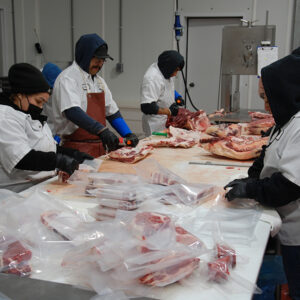
Beef tallow, pork lard, bone broth — these and other products often associated with micro-processing ventures are a growing part of Nordik Meats, a USDA-inspected plant with 25 employees serving a handful of grassfed/alternative meat marketing organizations in addition to much smaller producers having processing done for their own consumption and direct-market sales.

Certainly the traditional cuts account for the bulk of Nordik’s business. Grassfed beef and lamb, plus pastured pigs, are by no means everything the plant does: Joel says that grassfed accounts for roughly half of the total volume here.

But Joel sees grassfed meats and the associated added-value products as important to Nordik’s future as “cornerstone” customers such as 99 Counties (Graze January 2023) and Wisconsin Meadows innovate and grow, and smaller, often direct-to-market ventures tap rising interest in grass-finished, organic, and local meats.

Continue reading “Processor values grassfed demand”
Bringing a new generation into dairy

MacKenzie Wallace finds a place on 156-year-old grazing farm

By Martha Hoffman Kerestes

Whitingham, Vermont — MacKenzie Wallace knew he wanted to make a career in the grazing dairy world. He also knew it would be a challenge since there was no family farm to work into. 

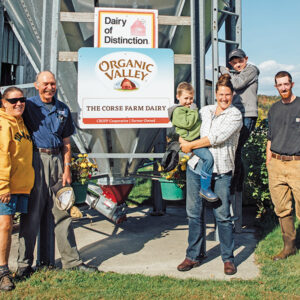
A few turns in the road later, this young Dairy Grazing Apprenticeship (DGA) graduate is working with seasoned dairy grazier Leon Corse in south-central Vermont (Graze April 2020) where he completed his apprenticeship in 2021. 

When MacKenzie first came back as hired labor earlier this year, he started taking on more management decisions. He is now being transitioned into the operation more fully. 

They’re both optimistic about the future. 

Getting into dairy 

MacKenzie didn’t grow up on a farm, but he gravitated toward agriculture nonetheless.

Continue reading “Bringing a new generation into dairy”

Finding opportunities in obstacles

From low milk prices to 100% raw sales with the CSA model

By Martha Hoffman Kerestes

Alfred Station, New York — After four decades of dairying, hauling costs and low milk prices made shipping grassfed organic milk unsustainable for the Snyders. Sometimes the milk check hardly covered the electric bill. 

For Kelby and Kristina and Kelby’s father Jerry, there were two choices: stop dairying or massively scale raw milk sales. 

The odds looked stacked against the raw milk option. The farm isn’t in a densely populated or wealthy area, New York regulations only permit on-farm sales, and current raw milk customers were relatively few. It was going to take some serious creativity to make a go of it.

In the face of the unknowns, the family took a leap of faith and gave notice to their milk buyer in November 2022. The milk truck came for the last time on April 29, 2023.

CSAs were the ticket

Existing raw milk sales were consistently 30-50 gallons a week. The 45-cow herd milked once a day was producing about 500 gallons weekly, so the Snyders needed to make ten times the current sales. A tall order, but they believed the demand would be there and therefore didn’t scale down the cow herd.

Continue reading “Finding opportunities in obstacles”

Weak links

Food system’s weaknesses show need for something better

By Allen Williams
The Covid-19 pandemic has created significant upheaval across the world, and certainly right here in the U.S.

With the shelter-in-place orders, restaurants closing to inside dining, and schools and universities shutting down in-person education, the impact on agriculture and the food industries has been monumental.

Continue reading “Weak links”

Price alone won’t solve our problems

Farmer with dog and cows

By Joel McNair

Many dairy farmers believe that low milk prices are the biggest danger to their livelihoods. For more than a few, the thought is that the best solution would be a Canadian-style supply management program to boost milk prices and keep them at profitable levels.

I don’t buy all of the arguments for quotas and such, and there is no reason to believe that our elected representatives will ever enact anything approaching Canada’s system. Continue reading “Price alone won’t solve our problems”

Drawing the line using peasant wisdom

Jim VanDerPol

By Jim Van Der Pol

Kerkhoven, Minnesota — We had been talking about the new dairy factories here in western Minnesota, my friend and I. We finished adding the 4,000 cows in the first one to the 10,000 in the next one, then the 10,000 cows in the just-completed one as well as the 10,000 in the just-proposed one. That is 34,000 cows, all within 12 miles of my house.

I told my friend that the dairy factories imported young men from South America to do the work and constructed bunkhouses at the site so they wouldn’t be bothersome in the town and create a public relations problem. Then, speaking from the experience of a lifetime in dairy farming, came his question: Continue reading “Drawing the line using peasant wisdom”