Opitz on grazing: Keeping up with spring grass

C. Opitz

Spring pasture management may be the most difficult task in farming. The weather is so variable that a management tactic based on calendar dates and specific strategies that worked last year may fail miserably this year. Grass availability can turn from shortage to surplus in the space of a few days, and it can rain on that surplus for days at a time. Mistakes and bad breaks in spring can haunt grass farmers through the rest of the year, with poor summer production and lots of poor hay in storage. Yet fortune and good strategies can you give your pastures a chance to be productive during dry summer weather, and give you the ability to supplement with the quality forage made in spring.

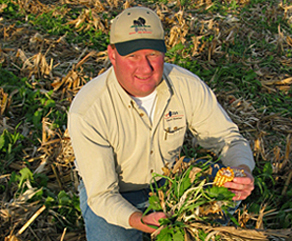
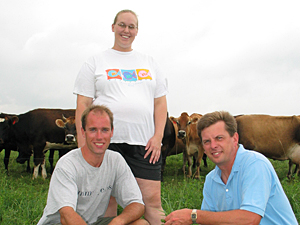
While everyone screws up spring grass management at least once in a while, the Opitz dairy farm in southwestern Wisconsin probably screws up a lot less than average. With more than 2,000 cattle on 3,000 acres of rolling and rough ground, Charles Opitz, his son Mark, and herdsman Keith Ekstrom have their hands full every spring. But they usually come out of it with pastures set up well for the summer season, and a fair amount of decent quality pasture haylage in a pit or wrapped in bales. Continue reading “Opitz on grazing: Keeping up with spring grass”

Different ‘grass-fed’ beef categories require differing strategies

Cows on pasture

By Tom Wrchota, Omro, Wisconsin — Ever since living and working in Costa Rica back in the early 1970s, I have greatly enjoyed the taste, smell, and texture of “properly” raised and prepared grass-fed beef. Once back in Wisconsin, it was one of my crusades to develop a beef herd and a grass management system that could service my acquired beef appetite … along with making a living selling it to other prospective affectionatos.

After 11 years of being part of this emerging sector, I’ve come to a few conclusions about what represents grass-fed beef quality, and how a northern grazier might be able to produce a relatively consistent product. They’re based on laboratory tests, blind taste panels, and my own, on-ranch observations. Continue reading “Different ‘grass-fed’ beef categories require differing strategies”

Musing on Dad’s mistakes

Jim VanDerPol

By Jim Van Der Pol, Kerkhoven, Minnesota — I was raised to farming. Most of my “indoctrination” was carried out by my father. He truly believed that he who could farm certainly would, and that others would just have to be satisfied with a lesser lot in life. When I was a little boy, three or four perhaps, the instructions given for locating me were to “find Jake and look down.” The barn my parents built to replace the one that blew down on our former farm a few miles down my road still bears my three-year old footprints in the concrete.

Dad is gone. So is Mother now, and I have been amazed at how very intimidating it has been to find myself in the predicament of being the oldest, at least in that my generation is the oldest. The idea that I am or ought to be speaking from experience is confusing. How did I get so far so fast? My confusion is worsened by the knowledge that I do not in any sense “know” what my parents knew, even though all of us are, or were, farmers. Continue reading “Musing on Dad’s mistakes”

Year-round, Corn Belt grazing

Farmer with forage

Cliff Schuette employs annuals and fescue in 12-month beef grazing program

Breese, Illinois — “If you’re paying for the ground year-round, you might as well try to graze it year-round.” While Cliff Schuette’s rationale may be sound, this grass-farming grail is simply not attainable for northern graziers.

Then again, Cliff and a few others like him are showing that perhaps year-round grazing — or at least something very close to it — is not quite the mirage many graziers made it out to be. In recent years Corn Belt graziers have been employing annual crops and stockpiling tall fescue in successful efforts to graze at least some stock 12 months a year, thus cutting feeding costs to levels far below conventional norms for their areas. Continue reading “Year-round, Corn Belt grazing”

Managing for birds … and profit

Bird on grass stem

By Laura Paine, Portage, Wisconsin — One of the small pleasures of grass farming is watching and listening to the songbirds that share our farms in spring and summer. Grassland songbirds don’t do anything for the bottom line, but they can be indicators of environmental health. If our farms are capable of sustaining not only our families and livestock, but also a complex community of plants and animals, we know that we are part of a healthy, resilient, and fundamentally sustainable system.

And perhaps there is more of a distinct bottom line to this idea. For instance, Minnesota grazier Art Thicke has found that some of the same practices that are good for birds also improve forage utilization and contribute to the long-term productivity of his pastures. There are ways to improve songbird-nesting habitat that can work within a profitable grazing operation. But first, let’s think about the landscape from a bird’s perspective. Continue reading “Managing for birds … and profit”

Fall is for rebuilding ewe body condition

Sheep on pasture

By Janet McNally, Hinckley, Minnesota — How you manage your ewes between September 1 and November 1 will make or break next year’s lamb crop. Once winter weather sets in, outwintered ewes seem to be challenged to gain any further weight, especially if they are starting off thin. For us the magic date seems to be November 1. Whatever we can achieve by then is what our flock has to live with for the rest of the winter. Body condition determines ovulation rate, ability to withstand the cold, and future milk production. Sure, you can purchase body condition by supplementing heavily with the grain pail, but the same can be achieved on pasture through management without spending a dime.

There are three components to fall sheep management that will determine what kind of body condition your ewes will be sporting when the rams go in. The first is weaning date, the second is pasture allowance after weaning, and the third is intestinal parasite status. Mismanage any one of these three, and you have to pay, either through reduced lamb production the following year, or through purchased supplements. Continue reading “Fall is for rebuilding ewe body condition”