The problem with Roundup Ready food

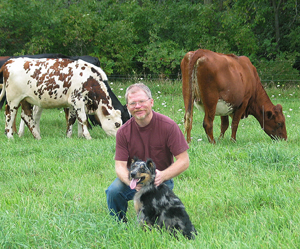
Farmer with dog and cows

By Joel McNair, Belleville, Wisconsin —For a few years now — basically since his retirement from Purdue University — plant pathologist Don Huber has been telling people that there are serious problems with glyphosate (Roundup).

To date most of the discussion has taken place within the world of soybeans. Based on two decades of his own research along with the findings of other scientists, Huber is certain that glyphosate is reducing the ability of the soybean plant to take up and utilize manganese, thus reducing yields. It is a charge roundly denied by Monsanto and many mainstream agronomists. Continue reading “The problem with Roundup Ready food”

Sheep add value to organic crop rotation

Ontario family shows they can cut costs, add income on tillable land

By Janet McNally It has always been my contention that sheep in the Grain Belt should be a part of a mixed crop and livestock farm. In most parts of the world, sheep are not the only enterprise on tillable cropland. They are employed as integral components of cropping programs by assisting with weed control and soil fertility, and in marketing crop residues.

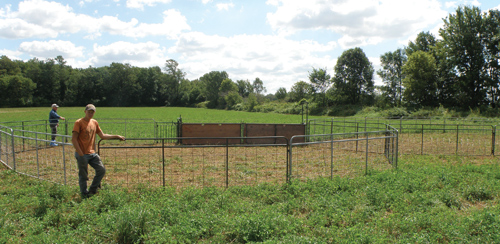
Photo: Janet McNally. To smooth the weaning process, the Boettchers set up a temporary pen and chute, and allow lambs to play there for a few days before they’re sorted. Son Martin is in foreground.

With the right approach, sheep are a very profitable addition to such farms. Modern agriculture has encouraged mono-cropping, with fertilizers and farm chemicals replacing livestock as crop management tools. Mono-cropping livestock has been a growing trend as well. Continue reading “Sheep add value to organic crop rotation”

Following the money in a grass-fed business

Cows on pasture

Analysis shows some surprising profit results from cow-calf and finishing after two winters

By Tom Wrchota, Omro, Wisconsin — Grass-fed beef is hot. More and more people are questioning the safety and quality of conventional beef and are willing to pay premium prices for grass-fed even during this recession. While we’ve had to work a little harder to sell steaks, we can’t keep up with demand for our premium hamburger and some of the other cuts. The hype is amazing, and the future seems bright.

But are we making any money at this? When Susan and I started Cattleana Ranch 17 years ago, we set out to achieve a profitable agricultural business while maintaining a simpler life working on a small livestock farm. Continue reading “Following the money in a grass-fed business”

In Europe, it’s put your money in, get your raw milk out

In Europe, buying raw milk can be as simple as putting some money in a vending machine and filling a bottle.

“In all of Europe you will find some form of milk machine,” said Sylvia Onusic, a nutritionist and food writer. The phenomenon started in Switzerland, and each European country establishes its own rules regarding vending sales. Italy alone has more than 1,300 such machines, she told attendees at the recent International Raw Milk Symposium in Madison, Wisconsin. Continue reading “In Europe, it’s put your money in, get your raw milk out”

Turning dairy feeding wisdom on its head

Farmer with cow

Jim Gardiner adds molasses, but no grain, to great forage in making 16,000 lbs./cow

Otselic, New York — Talk to Jim Gardiner for any length of time, and you’ll realize he is turning conventional dairy feeding wisdom almost completely on its well-established head.

Jim says the ultra-fast breakdown of molasses in a cow’s rumen is a good thing, while the propensity for corn to slow the passage of grazed pasture is bad. Corn creates rumen heat and exacerbates summer overheating compared to a forage/molasses ration, he asserts. Corn actually increases the problems caused by urea in the blood of cows consuming high-protein forages, rather than reducing them as conventional science asserts. Continue reading “Turning dairy feeding wisdom on its head”

Calf housing made cheap, easy and efficient

These panel-and-tarp hutches offer a nice environment for the calves, and labor savings at a low cost for Lee Kurtenbach. The structures are dismantled after weaning, allowing bedding packs to be cleaned and the entire line to be moved a few feet for the next spring’s calf crop. Photo: Lee Kurtenbach

Mechanicsville, Iowa— With more than 400 cows to milk and not a lot of labor on hand, Lee Kurtenbach likes things simple, efficient, effective and cheap. That’s why he’s using wire stock panels covered with tarps to house some 90 separate groups of young dairy calves, five to a group.

Lee calves seasonally starting in early March, and keeps his Jersey bulls until they’re actually worth some money. He needs some shelter in his southern Iowa climate and likes portable calf housing, but in Lee’s view fiberglass domes and the like are too expensive and too much work. Continue reading “Calf housing made cheap, easy and efficient”