Thinking outside the box with grazing


Amos Stoltzfus is finding his path as a first-generation dairy grazier

By Martha Hoffman Kerestes


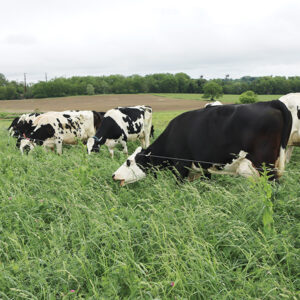
Kinzers, Pennsylvania — Amos Stoltzfus was new to grazing when he started in 2017. He’s made that fact an asset.

There’s no “way we’ve always done it” with a new farm and a new venture, so Amos has been experimenting with a variety of grazing and livestock management methods to see what fits on his operation. And he’s not afraid to adjust routines if a better way comes along.

“We have to be open minded to changes,” he says. “It doesn’t have to be done this way every time. Nature is never the same — weather patterns, growing seasons. Why should we do things always the same way?”

Shifts in markets

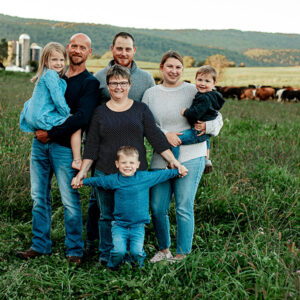
Amos and his wife Rachel milk around 40 cows for Maple Hill’s grassfed organic market on 70 certified organic acres. They’ve come a long way since starting eight years ago with 50 purchased yearling heifers.

The farm was certified organic when Rachel’s father bought it and asked the couple if they wanted to dairy on it.

There wasn’t an organic market available at the time, so when the heifers freshened, the milk went to a conventional market. But Amos didn’t use any prohibited inputs that would make the land lose its organic status.

Continue reading “Thinking outside the box with grazing”

From seasonal conventional to organic


Low-input dairy graziers make shifts for long-term sustainability and efficiency

By Martha Hoffman Kerestes


Belleville, Pennsylvania — After 30 years shipping conventional milk on a spring-seasonal schedule, the Bylers switched to the Organic Valley truck and moved to bi-seasonal calving. 

But that’s just one of many adjustments they’ve made over time to set the farm up for short- and long-term success.

Low-input management is the cornerstone, and that means outwintered herds, nurse cows, natural service, limited machinery, and more. Matt Byler, 53, and his son Garrett, 31, run the 250-cow dairy with a full-time DGA apprentice and a part-time employee. 

Cows doing the work

The Bylers manage around 750 rented and owned acres, although some are still in the process of organic transition. Their central Pennsylvania ground is relatively flat. The milking herd has access to the 320-acre home farm for year-round grazing, and there is off-farm acreage for young stock and dry cows.

All grain is purchased — the herd gets 10 lbs./head/day in the parlor. The pelleted mix is primarily ground corn and provides 20-25% of cows’ dry matter needs for the day. At times the herd gets some purchased corn silage too.

Continue reading “From seasonal conventional to organic”

Working into grassfed dairy ownership


First-generation graziers find a future

By Martha Hoffman Kerestes


Garnavillo, Iowa — A few years ago, two young folks left existing careers in search of a more fulfilling life. Today, they’re married and building that fulfilling life together working into ownership on a dairy, as a longtime grazier passes the torch.

Nicole Blanchette, 30, grew up in suburbia and hadn’t been on a farm. She realized her post-college research job at a hospital wasn’t what she wanted to do for the rest of her life. 

The Covid-19 pandemic was the last straw — she wanted to be out of her downtown Chicago apartment. She thought, “I like being outside, I love food, and I love animals, so maybe I should try farming.”

That led Nicole to Cliff McConville’s All Grass Farms not far away, and she joined the operation as a Dairy Grazing Apprentice through DGA. There, she fell in love with dairy and realized this was what she wanted to do with the rest of her life.

She was about to graduate when she met Paul Blanchette, 37, but they almost didn’t cross paths.

Continue reading “Working into grassfed dairy ownership”

A growing herdshare business


Nurse cows and tall grazing help make the system work smoothly for the Bairs


By Martha Hoffman Kerestes


Troy, Ohio — Two dozen years after first turning their conventional herd out to pasture, David and Annette Bair are bringing on the next generation, milking 48 cows for one of the largest herdshare programs in Ohio, and eyeing more growth as demand continues to expand.

It’s a long way down the road from where things were at when David got fed up harvesting feed for the confinement dairy around the turn of the century. He was moving from 3rd and 4th cut hay straight into corn silage and then directly into high moisture ear corn, and it was a lot of time to spend on the tractor.

“I was spending every day for 90 days that the weather was fit in the tractor chopping, and it was costing a lot of money to do that,” David says. “I just thought we could do better if we could just send the cows out and harvest their own feed.”

When he pitched the idea of letting the cows out to graze, his dad was hesitant but willing to try.

“My dad’s biggest fear was ‘what if it turns dry?’,” David explains. “He was worried pasture wouldn’t be able to keep supplying forage if it turned dry.”

David seeded 25 acres and grazed the herd in 2001 for part of their ration. And one part of his father’s fear came true as the season turned dry, but the pasture didn’t fail them.

Continue reading “A growing herdshare business”

Building a first-generation dairy


Shipping milk and making cheese are a winning combination for the Webbs


By Martha Hoffman Kerestes


Enosburg Falls, Vermont — Tyler and Melanie Webb are first-generation dairy farmers. In fact, Tyler hadn’t ever milked a cow when his herd started calving, so he had to ask a neighbor to come over and show him how to use the milker.

But almost two decades into dairying, they are seasoned graziers with a spring-seasonal herd, an Organic Valley market, and an artisan cheese business.

The Webbs steward around 400 acres, with 275 owned and the rest rented. There are 160 acres of pasture and 120 acres for perennial stored forage, and the rest of the land is managed woodland or set aside for riparian, wildlife, and pollinator habitat. There are 70 milking cows here on the farm in northwestern Vermont.

“Efficient grazing machines”

The farm consists of mostly silt loams. Rocks abound (hence the name Stony Pond Farm), so sward change happens through frost seeding improved red and white clovers, not tillage and reseeding. Management is part of it too.

“Our main route for improving pastures is through stocking density and frequency of moves,” Tyler explains.

Continue reading “Building a first-generation dairy”

Setting up for growth in grassfed


Changes to management and infrastructure are key for the Hershbergers


By Martha Hoffman Kerestes


Editor’s note: Graze likes to check in with previously featured farmers. Here’s an update from a northeastern Ohio grassfed dairy producer (Graze March 2020).

Fredericksburg, Ohio — Infrastructure and management changes have set the stage for David and Emily Hershberger’s dairy to grow.

The main goal is to open the door for the next generation.

“Our son got married, and he’d like to come home and farm,” David explains.

A new parlor, groundwork for freestall expansion, and management changes like fall-seasonal calving and nurse cows are part of pursuing that goal.

And since the couple and their 12-year-old daughter Eve are the only labor right now, those changes also make things more manageable from a labor standpoint.

Continue reading “Setting up for growth in grassfed”