
The Importance of Mychorrhizal Fungi
- Lissy Matthews
- Jan 20
- 5 min read
Updated: 2 days ago
By Allen R. Williams, Ph.D.
This article first appeared in the January 2023 issue of Graze. We're sharing it here in full to give you a taste of the practical content we offer in each issue of the magazine. For the full meal, subscribe today!
We at Understanding Ag have looked at tens of thousands of soil test results that combine Haney, PLFA, and TND (Total Nutrient Digestion) tests. The Haney test is similar to a traditional soil test, but it also supplies us with a 30,000-foot view of soil health by testing for soil microbial respiration, organic carbon fraction (WEOC), microbially active carbon (MAC), and the carbon-to-nitrogen ratio (C:N).
The PLFA is a pure soil biology test that looks at parameters such as total living microbial biomass, total bacteria, total fungi, mycorrhizal fungi, saprophytic fungi, and protozoa. The TND test provides a look at the complete mineral composition of the soil at sampling depth.
This article is not going to go into detail about these tests and how to interpret them. Rather, I will use the results from tens of thousands of these tests over the breadth and depth of North America to show what the vast majority of our agronomic soils are missing. This includes both cropland and pastureland.

Time after time when we look at the results of this suite of soil tests, we find one thing in common on a too-repetitive basis. The vast majority of our soils are deficient in one thing.
Not nitrogen, not phosphorus, not calcium, not another element (B, Cu, Zn, Mn, Mg, Al, etc.). Not what we would suspect as the “usual” culprit. As a matter of fact, the deficiency is not an element (mineral) at all. It is not organic matter or carbon. It is actually a soil microbe.
Mycorrhizal fungi.
That’s right. The biggest deficiency we see in almost all cropland and pastureland we have tested is a microbial species that plays a very large role in soil health.
Mycorrhizal fungi (MF) are often found to comprise less than 4% of the total living microbial biomass in our soils. Greater than 90% of all the soil samples we look at are dominated by bacteria, often in the 85 – 95% range, and they are terribly deficient in MF.
Benefits of MF
Why is this so alarming? Because MF control a number of key functions in the soil.
Since this is not an article about MF, but rather how we correct the situation, I will list only the top key functions of MF in our soils. They:
interconnect all plant roots in a continuous field and even between fields
send signals to all plants when plants in one area of a field are being preyed upon by pests
produce biotic glues that stick tiny soil particles together to form much larger soil aggregates for significantly improved water infiltration and retention, thus relieving soil compaction
capture nutrients in the soil and feed them to the plants
act as the plant’s principal immune system against fungal disease
move nutrients within a field from an area of higher concentration to an area of lower concentration, and
greatly extend the reach of an individual plant’s roots.
What do soils with high levels of MF look like? They will have significant soil aggregation as in the above photo, and the plant roots will be surrounded by a soil coating (next page).
Building mycorrhizal fungi populations
With all of these important functions, it stands to reason that we would want to encourage and facilitate far better MF populations in our soils. The question is, just how do we accomplish that? What are the management strategies and practices we can implement to encourage greater mycorrhizal colonization and population growth?
Here is how we can do that:
Focus on growing plants that have strong mycorrhizal associations. These are grasses and certain forbs (or plants we call weeds). Most of the grasses we grow have good to great MF associations. If we rank them in their ability to form strong and vast MF populations, we rank warm season grasses (C4) ahead of cool season grasses (C3). Both have good MF colonization ability, but the C4 grasses are better at this.
Focus on perennial species as much as feasible. In comparing annual species to perennial species, the perennials have the upper hand. It is not that annual grasses cannot form MF associations, because they do. Rather, it is because the perennials form much stronger and longer lasting MF associations.
Woody and brushy plant species tend to have very strong MF associations, so strategically incorporating them into our pastures and into mixes can help forge stronger MF populations. Rather than hate those areas with blackberry, buck brush, sumac and other woodies, use them strategically in your grazing to spread mycorrhizal populations across your pastures. This holds true for many weedy species as well. For example, dig beneath thicker patches of thistle, cocklebur or mare’s tail, and you will see soil that is fairly well aggregated.
Mature plants carry greater amounts of MF spores than do highly vegetative plants. Most graziers strive to keep their grasses as vegetative as possible during the active growing season, but vegetative grasses will not be as mycorrhizal as those with more maturity. Allowing plants to gain greater maturity before we graze them can spread MF populations.
We can use our livestock as tools for spreading MF colonization by sometimes grazing them in more mature paddocks and then moving them to paddocks that lack good MF populations. They spread MF spores in their manure.
Avoid all forms of tillage as much as possible. Think of your mycorrhizal fungi population as a giant roll of gauze. If you unrolled a giant roll of gauze on your pasture or field and then used any form of tillage, what would happen to the gauze. It would be cut to shreds. All forms of tillage damage mycorrhizal fungi, and the damage takes a long time to repair.
Frequency of mowing and/or grazing significantly affects mycorrhizal populations. The more you mow, the lower the MF population will be. We see this in hayfields. And the more frequently you graze a pasture, the lower your MF population will be. Too many graziers come back too soon after a previous graze, hitting a pasture every 30 or 40 days. Do not expect good MF colonization when that is the case. There are multiple reasons for this:
Grass is kept short, so the soil is more exposed to heating from the sun and moisture loss. Hot, dry soil is not conducive to MF.
Root growth stops. MF live in association with plant roots. Reducing living plant root mass means that you are lowering the active MF population.
Plant species diversity is reduced. This lowers MF species diversity and critical biomass.
Too much disturbance stimulates soil bacteria, which start voraciously seeking carbon sources of food from the soil. This includes the biotic glues produced by MF that aggregate soil particles. As the biotic glues are consumed, the soil aggregates disappear and the soil collapses on itself.
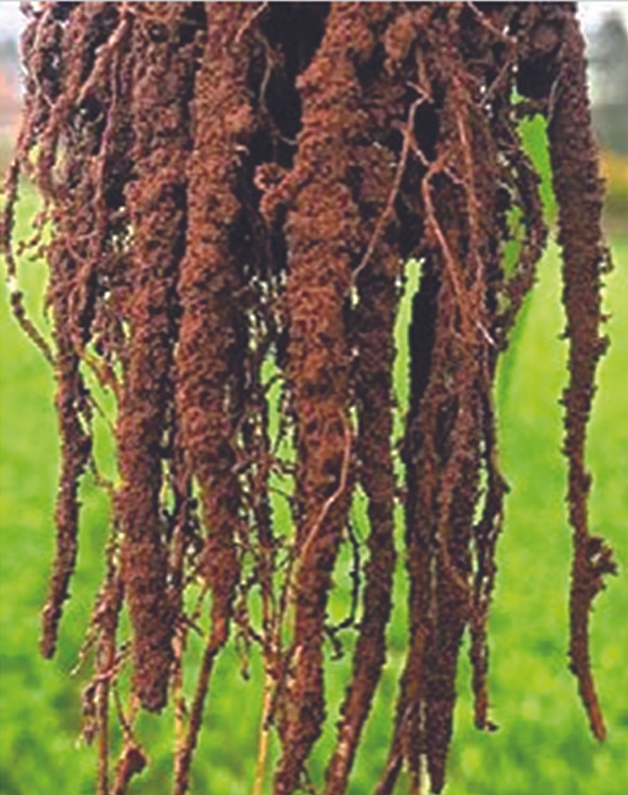
Roots, well-coated with the help of MF.
Focus on mycorrhizal fungi
Mycorrhizal fungi are the key microbial species lacking in most of our crop fields, hayfields and pastures across North America.
Since MF perform so many vital functions, this lack creates serious soil function issues. These include damaging the soil’s ability to infiltrate and retain water and cycle nutrients, along with compromising the ability of plants to resist fungal disease and pests.
Our focus needs to be on first restoring our mycorrhizal populations, then building them to a highly functional point. If we implement management strategies that build mycorrhizal populations, we get to enjoy the many benefits they confer.
Like what you're reading? Join our grazing community and subscribe today!


Comments